![[personal profile]](https://www.dreamwidth.org/img/silk/identity/user.png)
![[identity profile]](https://www.dreamwidth.org/img/silk/identity/openid.png)
Today's xkcd comic raises point:
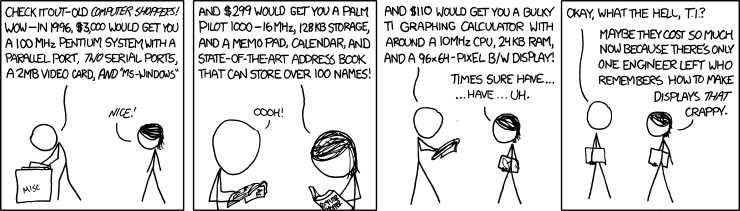
It seems awfully likely to me that graphing calculators have stagnated for some of the same reasons that textbook prices have skyrocketed. They're selected by people who don't have to pay for them, institutions tend to standardize on something and stick with it out of inertia, and their cost gets lumped in with the high cost of education (public or private).
I don't know what to do about graphing calculators (short of having everyone buy computers or something that they're likely to use ever again), but there are bound to be new possibilities in the works for textbooks. I'd think that some sort of free, "open source" textbook series could do quite well (especially if there were a reasonable way for college bookstores to print it on demand). Anyone out there know of such a thing in the physics world? (Intro physics especially.)
It seems awfully likely to me that graphing calculators have stagnated for some of the same reasons that textbook prices have skyrocketed. They're selected by people who don't have to pay for them, institutions tend to standardize on something and stick with it out of inertia, and their cost gets lumped in with the high cost of education (public or private).
I don't know what to do about graphing calculators (short of having everyone buy computers or something that they're likely to use ever again), but there are bound to be new possibilities in the works for textbooks. I'd think that some sort of free, "open source" textbook series could do quite well (especially if there were a reasonable way for college bookstores to print it on demand). Anyone out there know of such a thing in the physics world? (Intro physics especially.)
no subject
I know there's more going on than I can remember; I haven't had the spare cycles to follow closely, plus which academic publishing is such an insane pile of craziness that I quail at the thought of understanding the publishing & business models of open source textbooks. I know just enough about the open-access movement (not the same as open source, of course, but related, and closely in this case) to know that you would have to address vanity-publishing concerns to see widespread adoption; OA publishing is emphatically not the same as vanity press but faculty don't necessarily know that and without the imprimatur of a traditional publisher it can be unclear to people what the guarantees of quality are. But physics would be an obvious place to test open-source textbook generation models.
no subject
I do need to look more at OpenCourseWare (I'm only familiar with the MIT site). My impression has been that it aims to serve a rather different (and complementary) purpose than textbooks do. Neat stuff, regardless.
One question that's always nagged at me when using or creating various textbooks is copyright and attribution. For example, I usually write exam problems from scratch (or substantially altered from someone else's inspiration) but I have the impression that it's fairly common for people to simply grab problems out of other textbooks. Do the usual academic standards of proper citations and attribution apply? And how do you write a textbook for something like introductory physics without inevitably stealing ideas and approaches from the zillions of textbooks that you've used or examined in the past? I never know where to draw those lines.
Hmm. Maybe that last bit is its own blog post. :)
no subject
no subject
There's a definite temptation to write something calculator-like, both for quick computations at my computer and carrying around in my pocket: For some reason the computer computation tools are very powerful, and somewhat intimidating to learn. But there's still the adoption problem.
For textbooks, I think a lot of the problem is that it just takes a lot of editorial work to make a textbook usable. The markets tend to be fairly small, and the per-book portion of that cost is high. Open-source textbooks do exist, but last I checked they really weren't as good as the acceptable-grade commercial offerings.
no subject
And you're right about textbook quality: I've yet to see a free textbook that I'd be comfortable asking my students to learn from. I keep hoping, though. (One thing that could really help would be if some author whose book fell out of print and got the rights back would release it under a Creative Commons license or into the public domain. There would still need to be pretty strong control of the project by one or a few people for the "release" versions, or else the quality would quickly erode.)
no subject
no subject
A possible path to an open textbook might be to do a chapter-length piece on something that isn't well-treated in whatever you're using for the main textbook(s). I often do page-length sheets for specific topics, but that's quite different from what a textbook should provide.
no subject
It was used for many years at the high school I teach, until the district decided to standardize on a different $100 book. The students paid $5 for a physical copy (for the printing) or just used it online. It is quite a good book, I think.
The calculator problem I don't have an answer for...from a cheating aspect, from a familiarity of use aspect (for adoption), and from a cost perspective. all difficult.
no subject
no subject
As for calculators: one of the reasons the Wolfram Alpha iPhone App was originally $50 was that it made the iPhone into a very powerful graphing calculator for half the price. Now that it's $1.99, there's really no reason not to get it...