![[personal profile]](https://www.dreamwidth.org/img/silk/identity/user.png)
Today's xkcd comic raises point:
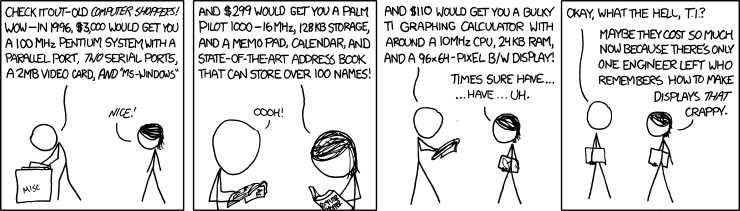
It seems awfully likely to me that graphing calculators have stagnated for some of the same reasons that textbook prices have skyrocketed. They're selected by people who don't have to pay for them, institutions tend to standardize on something and stick with it out of inertia, and their cost gets lumped in with the high cost of education (public or private).
I don't know what to do about graphing calculators (short of having everyone buy computers or something that they're likely to use ever again), but there are bound to be new possibilities in the works for textbooks. I'd think that some sort of free, "open source" textbook series could do quite well (especially if there were a reasonable way for college bookstores to print it on demand). Anyone out there know of such a thing in the physics world? (Intro physics especially.)
It seems awfully likely to me that graphing calculators have stagnated for some of the same reasons that textbook prices have skyrocketed. They're selected by people who don't have to pay for them, institutions tend to standardize on something and stick with it out of inertia, and their cost gets lumped in with the high cost of education (public or private).
I don't know what to do about graphing calculators (short of having everyone buy computers or something that they're likely to use ever again), but there are bound to be new possibilities in the works for textbooks. I'd think that some sort of free, "open source" textbook series could do quite well (especially if there were a reasonable way for college bookstores to print it on demand). Anyone out there know of such a thing in the physics world? (Intro physics especially.)
no subject
As for calculators: one of the reasons the Wolfram Alpha iPhone App was originally $50 was that it made the iPhone into a very powerful graphing calculator for half the price. Now that it's $1.99, there's really no reason not to get it...