![[personal profile]](https://www.dreamwidth.org/img/silk/identity/user.png)
![[identity profile]](https://www.dreamwidth.org/img/silk/identity/openid.png)
Today's xkcd comic raises point:
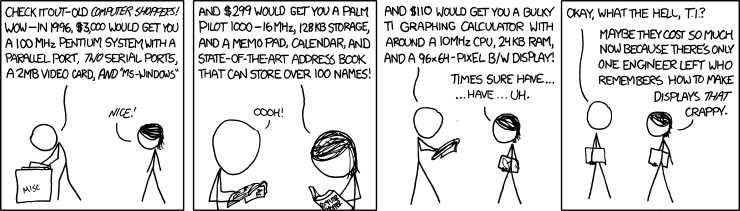
It seems awfully likely to me that graphing calculators have stagnated for some of the same reasons that textbook prices have skyrocketed. They're selected by people who don't have to pay for them, institutions tend to standardize on something and stick with it out of inertia, and their cost gets lumped in with the high cost of education (public or private).
I don't know what to do about graphing calculators (short of having everyone buy computers or something that they're likely to use ever again), but there are bound to be new possibilities in the works for textbooks. I'd think that some sort of free, "open source" textbook series could do quite well (especially if there were a reasonable way for college bookstores to print it on demand). Anyone out there know of such a thing in the physics world? (Intro physics especially.)
It seems awfully likely to me that graphing calculators have stagnated for some of the same reasons that textbook prices have skyrocketed. They're selected by people who don't have to pay for them, institutions tend to standardize on something and stick with it out of inertia, and their cost gets lumped in with the high cost of education (public or private).
I don't know what to do about graphing calculators (short of having everyone buy computers or something that they're likely to use ever again), but there are bound to be new possibilities in the works for textbooks. I'd think that some sort of free, "open source" textbook series could do quite well (especially if there were a reasonable way for college bookstores to print it on demand). Anyone out there know of such a thing in the physics world? (Intro physics especially.)
no subject
I do need to look more at OpenCourseWare (I'm only familiar with the MIT site). My impression has been that it aims to serve a rather different (and complementary) purpose than textbooks do. Neat stuff, regardless.
One question that's always nagged at me when using or creating various textbooks is copyright and attribution. For example, I usually write exam problems from scratch (or substantially altered from someone else's inspiration) but I have the impression that it's fairly common for people to simply grab problems out of other textbooks. Do the usual academic standards of proper citations and attribution apply? And how do you write a textbook for something like introductory physics without inevitably stealing ideas and approaches from the zillions of textbooks that you've used or examined in the past? I never know where to draw those lines.
Hmm. Maybe that last bit is its own blog post. :)