![[personal profile]](https://www.dreamwidth.org/img/silk/identity/user.png)
![[identity profile]](https://www.dreamwidth.org/img/silk/identity/openid.png)
Today's xkcd comic raises point:
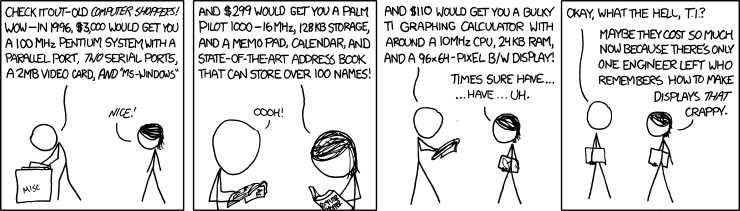
It seems awfully likely to me that graphing calculators have stagnated for some of the same reasons that textbook prices have skyrocketed. They're selected by people who don't have to pay for them, institutions tend to standardize on something and stick with it out of inertia, and their cost gets lumped in with the high cost of education (public or private).
I don't know what to do about graphing calculators (short of having everyone buy computers or something that they're likely to use ever again), but there are bound to be new possibilities in the works for textbooks. I'd think that some sort of free, "open source" textbook series could do quite well (especially if there were a reasonable way for college bookstores to print it on demand). Anyone out there know of such a thing in the physics world? (Intro physics especially.)
It seems awfully likely to me that graphing calculators have stagnated for some of the same reasons that textbook prices have skyrocketed. They're selected by people who don't have to pay for them, institutions tend to standardize on something and stick with it out of inertia, and their cost gets lumped in with the high cost of education (public or private).
I don't know what to do about graphing calculators (short of having everyone buy computers or something that they're likely to use ever again), but there are bound to be new possibilities in the works for textbooks. I'd think that some sort of free, "open source" textbook series could do quite well (especially if there were a reasonable way for college bookstores to print it on demand). Anyone out there know of such a thing in the physics world? (Intro physics especially.)
no subject
And you're right about textbook quality: I've yet to see a free textbook that I'd be comfortable asking my students to learn from. I keep hoping, though. (One thing that could really help would be if some author whose book fell out of print and got the rights back would release it under a Creative Commons license or into the public domain. There would still need to be pretty strong control of the project by one or a few people for the "release" versions, or else the quality would quickly erode.)
no subject
no subject
A possible path to an open textbook might be to do a chapter-length piece on something that isn't well-treated in whatever you're using for the main textbook(s). I often do page-length sheets for specific topics, but that's quite different from what a textbook should provide.