![[personal profile]](https://www.dreamwidth.org/img/silk/identity/user.png)
![[identity profile]](https://www.dreamwidth.org/img/silk/identity/openid.png)
I was thinking about color this morning (yes, I do these things), and I was struck by a disturbing thought: when did I last see violet? Not purple, which I see all the time, but actual violet. [I'm not the first person to wonder this: here's a very thorough discussion.]
Purple, as you no doubt recall, is a compound color: it's what we perceive when we see a mixture of red and blue light. But violet is a pure color: light with wavelength somewhere a little over 400nm. (Side question: anyone have a clue as to why purple and violet are perceptually similar?) So what's the problem? RGB monitors, that's what. The shortest wavelength of light produced by an RGB monitor is blue, which is probably around 460nm or so. That means that your monitor is incapable of producing a violet color. Looking at a picture of a rainbow on your computer screen is inevitably a less vibrant experience than seeing one in person.
So, fine, look at a printed photograph. Well... not so fast. I don't know how all the different types of photo printing work, but a lot of printers are RGB or CMY themselves (and I think that CMY has the same problems as RGB in this regard, or worse). I have no idea what the process is (or was) for traditional photo printing from the analog era, but I'm willing to imagine that there are photo printers today who are capable of printing with actual violet dyes. But wait: what sort of camera took the photograph? Again, I don't know how good traditional film cameras were at capturing violet, but today's digital cameras are (as far as I know) also RGB.
So: when did you last see violet? Think back: what does it look like?
Purple, as you no doubt recall, is a compound color: it's what we perceive when we see a mixture of red and blue light. But violet is a pure color: light with wavelength somewhere a little over 400nm. (Side question: anyone have a clue as to why purple and violet are perceptually similar?) So what's the problem? RGB monitors, that's what. The shortest wavelength of light produced by an RGB monitor is blue, which is probably around 460nm or so. That means that your monitor is incapable of producing a violet color. Looking at a picture of a rainbow on your computer screen is inevitably a less vibrant experience than seeing one in person.
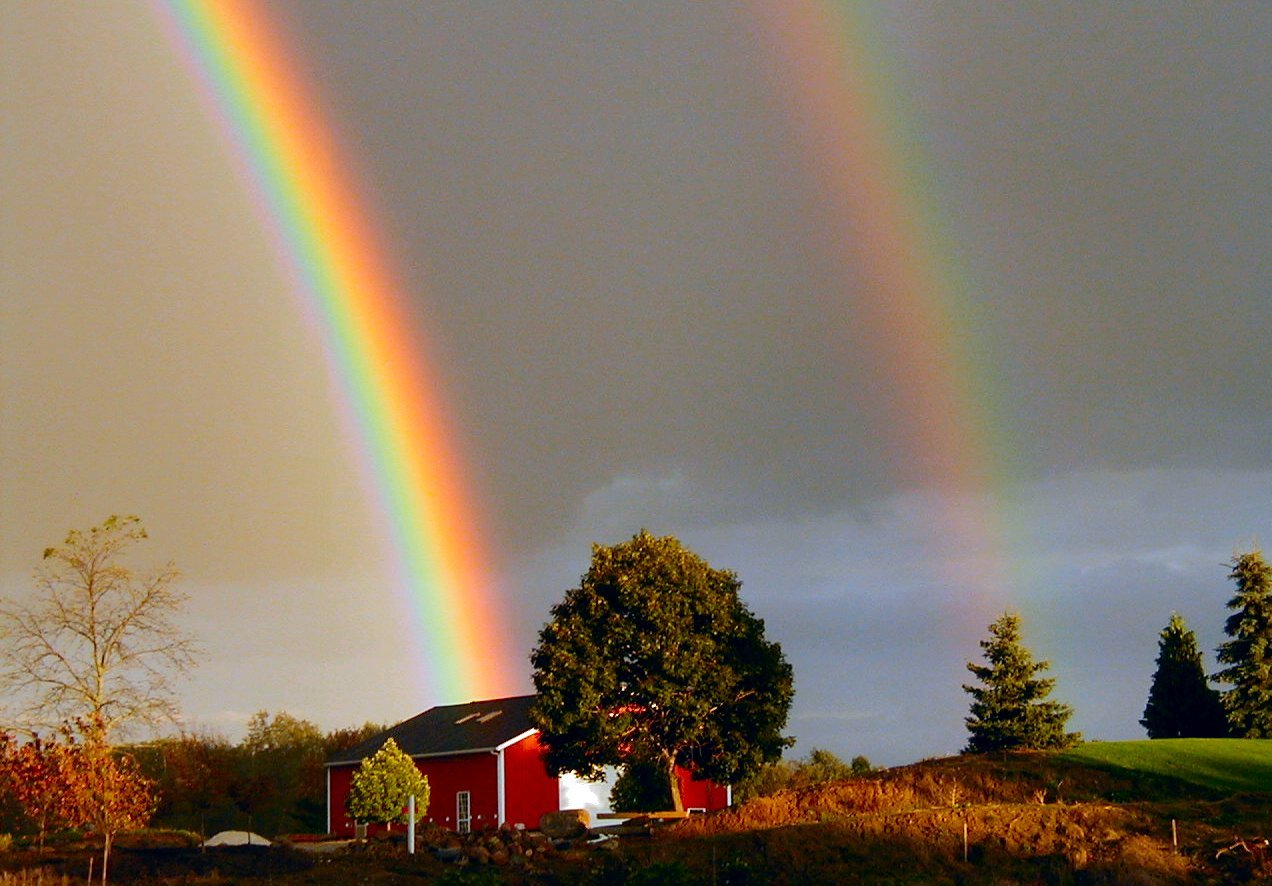
So, fine, look at a printed photograph. Well... not so fast. I don't know how all the different types of photo printing work, but a lot of printers are RGB or CMY themselves (and I think that CMY has the same problems as RGB in this regard, or worse). I have no idea what the process is (or was) for traditional photo printing from the analog era, but I'm willing to imagine that there are photo printers today who are capable of printing with actual violet dyes. But wait: what sort of camera took the photograph? Again, I don't know how good traditional film cameras were at capturing violet, but today's digital cameras are (as far as I know) also RGB.
So: when did you last see violet? Think back: what does it look like?
no subject
no subject
Also, unless digital camera sensors mimic that secondary peak (do they??), we'll still wind up missing out on violet in most photographs these days. (As
no subject
I am having trouble finding a good reference for this but an interesting coincidence from what I have seen before is the depth of color penetration in water. Red penetrates the least, blue the most. The coincidence is that from some graph a I remember seeing it made it lok like the color wheel was real... the penetration of orange was ~average(red, yellow) and the penetration of green was ~average(blue, yellow) which makes sense as a near linearization of the response curve. The coincidence is that because penetration depth drops off for shorter wavelengths then blue the penetration depth of violet is ~average(blue,red). The last one may have been less close then the others, but it was close enough that I simply dismissed it as the expect behavior given violet is blue plus red, false premise, strangely accurate result...
Complete speculation, but it occurs to me to wonder if this symmetric characteristic of the penetration depth has any relationship to why we would have the secondary red perception bump, causing violet to be perceived as purple. I have no idea what the causal chain would be, but if violet light behaves under enough natural conditions in a fashion similar to red mixed with blue it would then fit for this otherwise odd feature.