![[personal profile]](https://www.dreamwidth.org/img/silk/identity/user.png)
When our college president sent out his monthly campus update, I was pleasantly surprised to see my picture: he was happy about the very successful public viewing event that another professor and I arranged for the transit of Venus on June 5. (I'm up for tenure this fall, so the recognition is good!) We got an article on the front page of the local paper that morning, and between that and a campus email we wound up sharing the event with something like 150-200 people over the course of the evening.

It was a lot of fun. We gave people three ways to view the transit. They could stand in line to look through our good telescope (with its solar filter). (That's what's pictured above, though this was just my attempt at a hasty, imperfectly-focused shot right before I had to leave. You can barely even make out the cool sunspots in my picture.) They could look at a fairly large image projected on the wall (pictured below), which wasn't as clear but allowed lots of people to look at once. And finally, they could use my Harvey Mudd solar viewing glasses (thanks, HMC!): it was just possible to make out the round black disk of Venus blocking the sun without magnification, but that was one of the coolest parts of the experience for me.
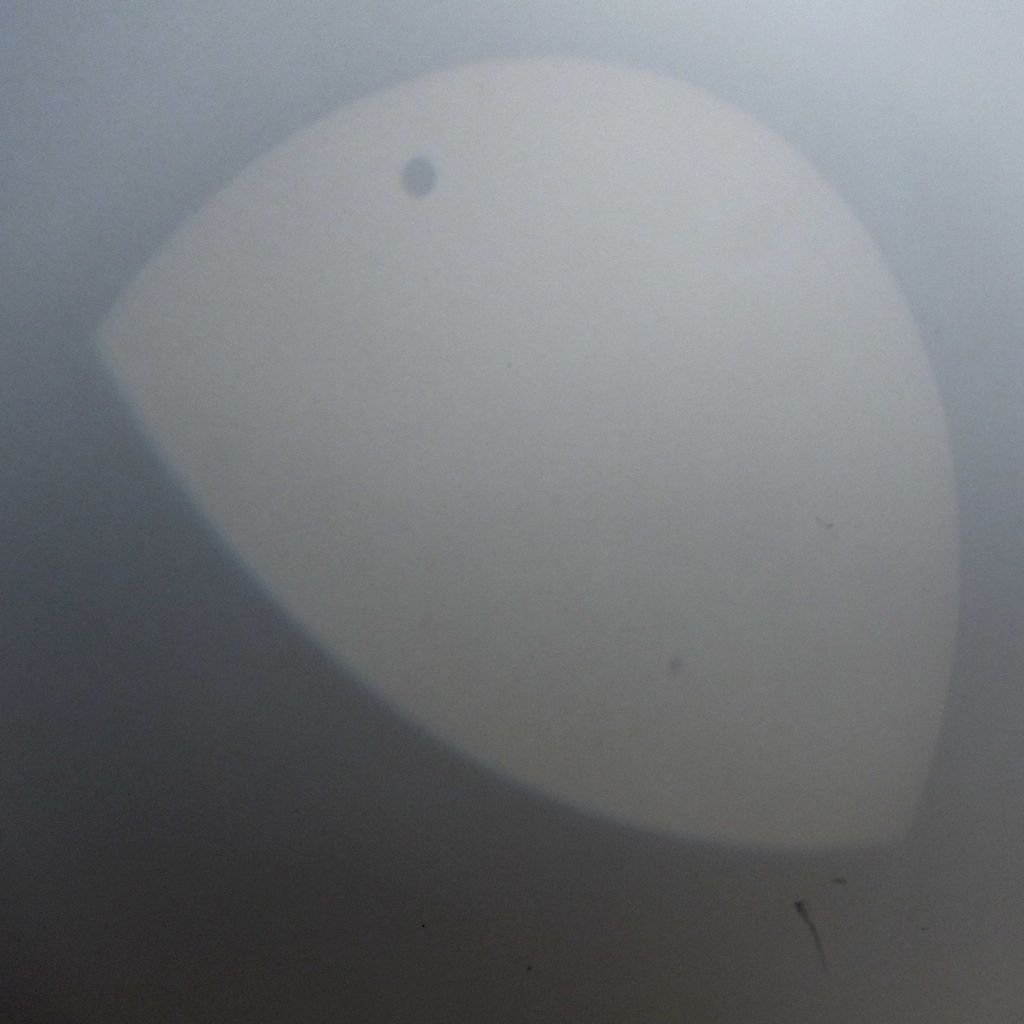
To share a few more pictures, here's the transit projected onto the wall (which took a great deal of finesse, let me tell you):

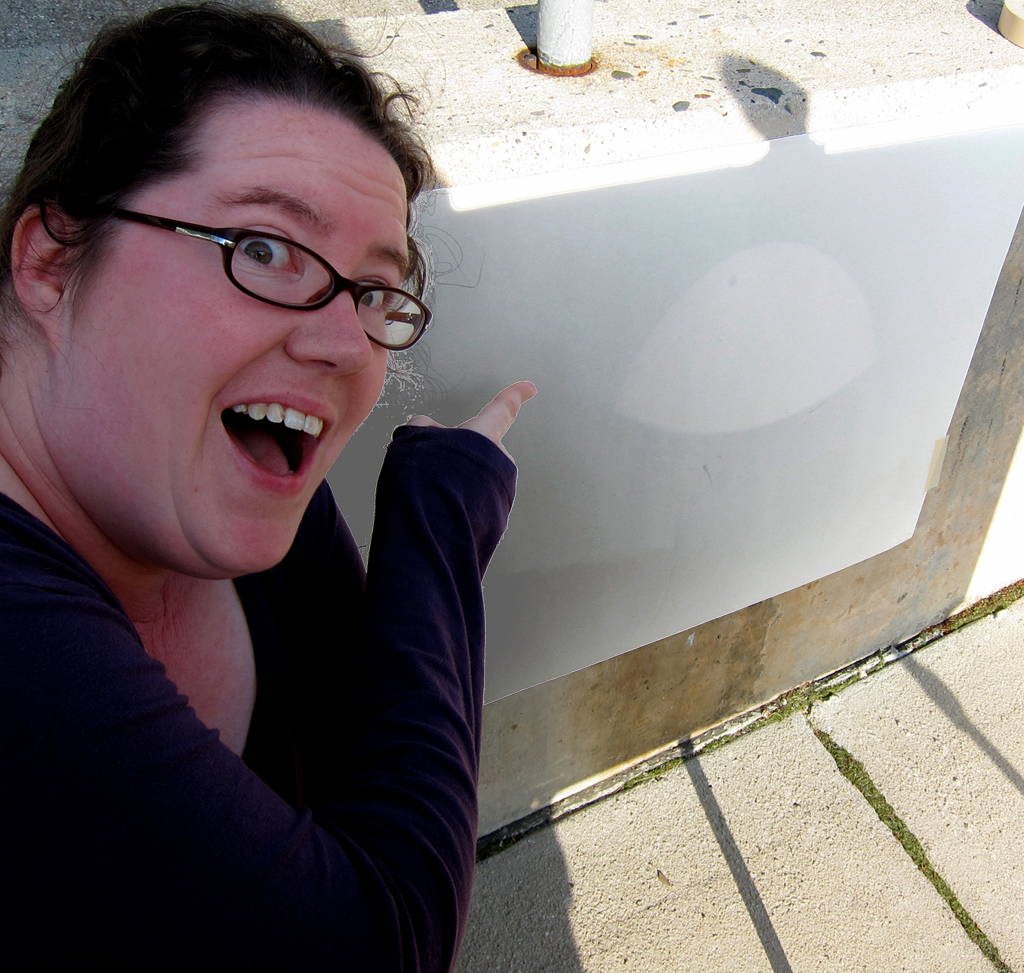
And here's our friend Megan getting very excited about it:

And finally, one more part of the event that I was proud of:

That last picture shows an impromptu scale model of the inner solar system that I set up on the football field (right next to the telescopes). I put a picture of the Sun on the 25 yard line, with the right scale to match Earth right on the goal line. Venus then wound up on the 7 yard line. If you click to zoom in on this photo, you might just be able to spot the tiny picture of Earth printed there (which is also to scale, along with the Moon and the distance between them). The solar system is big, and it's something of a miracle that these tiny little planets with their differently-tilted orbits ever manage to line up enough for transits at all. In fact, I got rather excited talking about all this to the crowd: a friend took a video of me giving my last "welcome chatter" of the night, after the crowd had thinned out a lot. (The college made its own video of the event, too. But it doesn't look like anyone thought to take pictures of the long line that we had for the first hour or so.)
Finally, the fun of the event and of tracking down pictures of the sun and planets for my scale model got me interested in making a poster of the planets to put up outside our planetarium. I spent a block of time hunting around NASA websites for big chunks of a weekend and a few evenings, and assembled this:

The full-resolution PDF will print 4'x3' with a resolution of at least 120dpi (and considerably more for many objects); I'll eventually be sharing it under a Creative Commons license. I'm pretty proud of it: you can't read them on this little picture, but each planet and moon comes with some interesting fact about the object. (There are very few posters like this based on real images, and too many of those obsess over dull numerical data instead of remarkable things like Mars's seasonal dry ice caps or Triton's probable geysers of liquid nitrogen.)
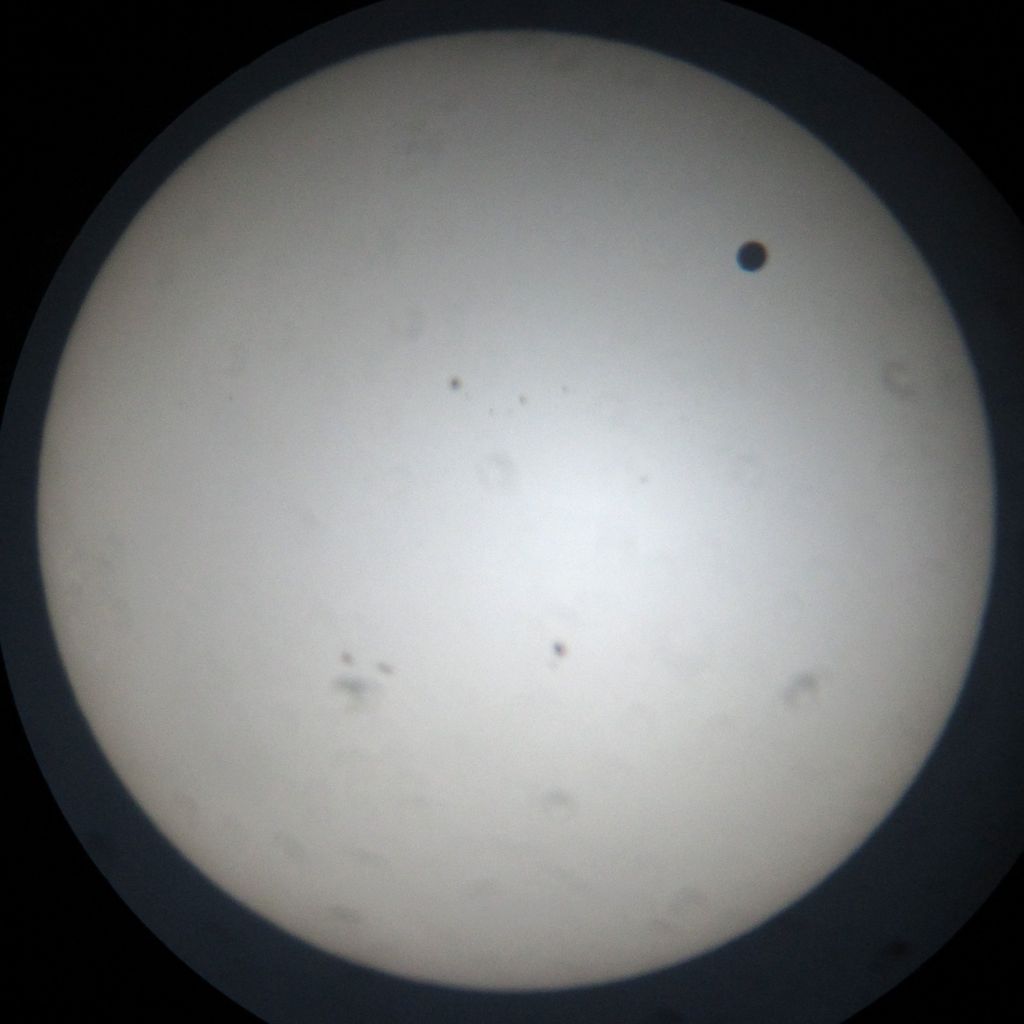
It was a lot of fun. We gave people three ways to view the transit. They could stand in line to look through our good telescope (with its solar filter). (That's what's pictured above, though this was just my attempt at a hasty, imperfectly-focused shot right before I had to leave. You can barely even make out the cool sunspots in my picture.) They could look at a fairly large image projected on the wall (pictured below), which wasn't as clear but allowed lots of people to look at once. And finally, they could use my Harvey Mudd solar viewing glasses (thanks, HMC!): it was just possible to make out the round black disk of Venus blocking the sun without magnification, but that was one of the coolest parts of the experience for me.
To share a few more pictures, here's the transit projected onto the wall (which took a great deal of finesse, let me tell you):
And here's our friend Megan getting very excited about it:
And finally, one more part of the event that I was proud of:
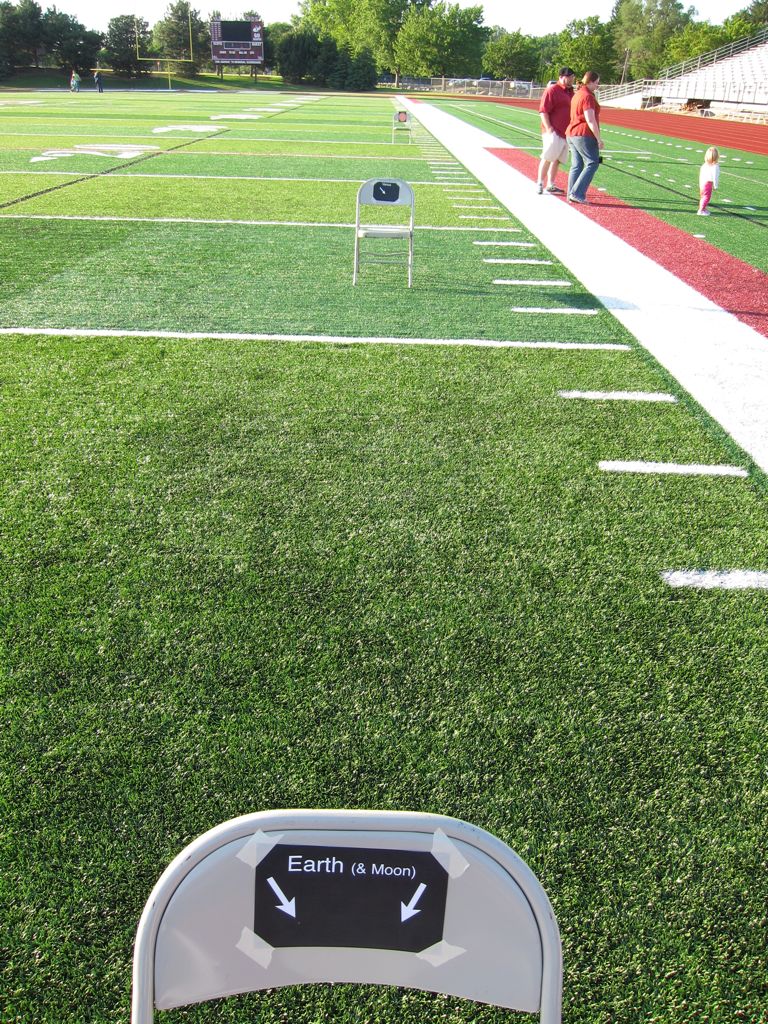
That last picture shows an impromptu scale model of the inner solar system that I set up on the football field (right next to the telescopes). I put a picture of the Sun on the 25 yard line, with the right scale to match Earth right on the goal line. Venus then wound up on the 7 yard line. If you click to zoom in on this photo, you might just be able to spot the tiny picture of Earth printed there (which is also to scale, along with the Moon and the distance between them). The solar system is big, and it's something of a miracle that these tiny little planets with their differently-tilted orbits ever manage to line up enough for transits at all. In fact, I got rather excited talking about all this to the crowd: a friend took a video of me giving my last "welcome chatter" of the night, after the crowd had thinned out a lot. (The college made its own video of the event, too. But it doesn't look like anyone thought to take pictures of the long line that we had for the first hour or so.)
Finally, the fun of the event and of tracking down pictures of the sun and planets for my scale model got me interested in making a poster of the planets to put up outside our planetarium. I spent a block of time hunting around NASA websites for big chunks of a weekend and a few evenings, and assembled this:
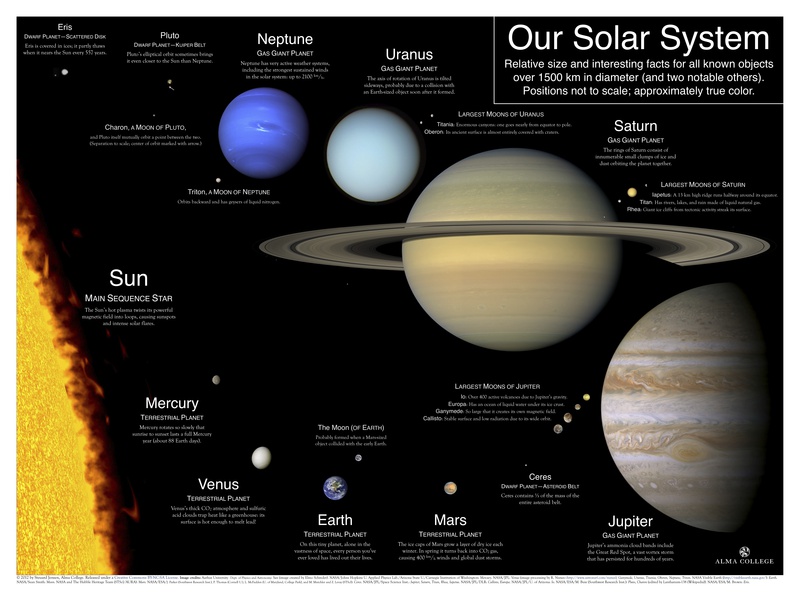
The full-resolution PDF will print 4'x3' with a resolution of at least 120dpi (and considerably more for many objects); I'll eventually be sharing it under a Creative Commons license. I'm pretty proud of it: you can't read them on this little picture, but each planet and moon comes with some interesting fact about the object. (There are very few posters like this based on real images, and too many of those obsess over dull numerical data instead of remarkable things like Mars's seasonal dry ice caps or Triton's probable geysers of liquid nitrogen.)
no subject
--Beth
no subject
no subject
no subject
Lots of existing posters focus on nice big images of each planet rather than on accurate relative sizes. And (as I mentioned earlier) almost every attempt to present facts about the planets winds up giving boring facts. And as for image selection, for a long time we just didn't have real pictures of Jupiter and Saturn in high enough resolution to work on a big poster, so artists' impressions became pretty standard. (It's still a bit dicey: this is the second-highest resolution true-color Saturn image released by NASA that I know of, and the resolution is borderline for a big poster. The highest resolution one isn't quite as good an angle for my purposes here. And I've gone with this partial (gibbous) Jupiter image because the second-highest resolution image is under 1000px in diameter: not enough for a 15" planet to look good!)
Now I just need to figure out how to print and mount this thing. Should I use our in-house printing service and track down some sort of foam core mounting board myself? Should I look for a printing service that might be able to do somewhat higher resolution and quality for 33% higher price (and quite possibly pay considerable shipping for a very large but somewhat delicate package)? We'll have to see.
(I'll have to tell you about the scale model I'm putting together in our science building, too.)